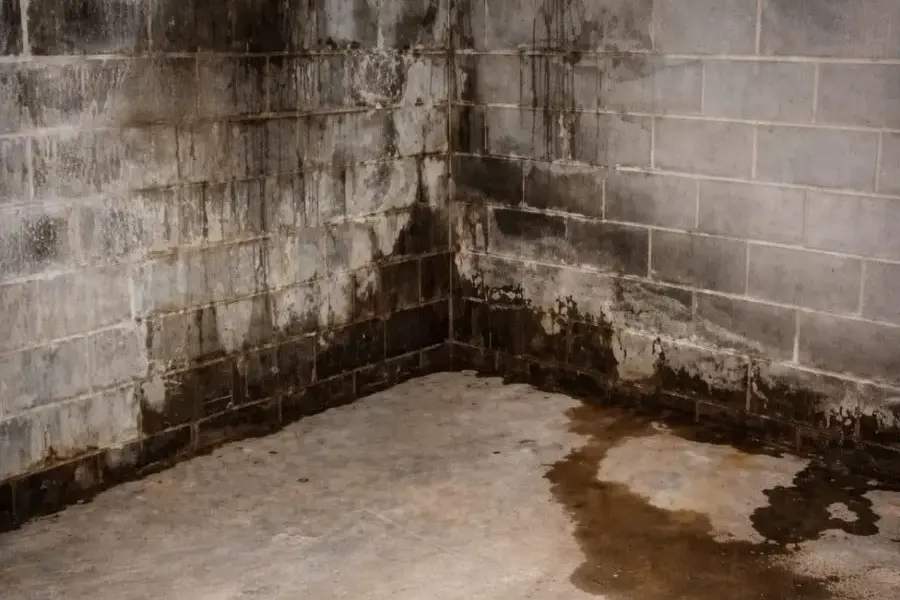
Why Warren foundations seep
Warren is built on flat clay left behind by the glacial lakes that once covered southeast Michigan. Clay holds water and swells, so after snowmelt or a week of rain the soil around a basement stays saturated and pushes water against the wall. That pressure finds the weak points in a 1950s or 1960s foundation:
- The cove joint, where the wall sits on the footing and meets the floor slab
- Hollow concrete block cores that fill with water and weep through the mortar
- Shrinkage and settlement cracks in poured walls
- Pipe penetrations and old window wells with failed drains
The damage you do not see
Seepage rarely makes a dramatic flood. It soaks the bottom plate behind paneling, wicks up drywall, and keeps carpet pad wet along one wall for weeks. The tech who does the walkthrough uses thermal imaging and pinless meters to map how far the water has traveled inside the finishes before anything is opened, so the removal matches what is actually wet.
Water that has sat in a wall cavity for weeks can support growth on the paper face of drywall, and the EPA's indoor air quality pages explain why damp basements affect the air in the whole house. That is why long-running seepage is often treated more strictly than a fresh leak.
Drying fixes the damage; it does not stop the next seepage. Downspout extensions, regrading and wall repair or interior drainage are what stop the water at the source.
Drying the wall and the finishes
The mitigation team removes wet pad, the lower drywall or paneling that meters flag, and soaked insulation, then the drying team runs air movers into the opened cavities with dehumidification sized to a cool basement. Block walls give up water slowly, so desiccant dehumidifiers are common on seepage jobs. For a basement that took on standing water, see basement flooding cleanup; for water coming from the pit, see sump pump failure cleanup. MSU Extension shares Michigan home and water material through its news and outreach articles.