Flooded basement help in Warren

Basement Flooding Cleanup in Warren, MI

A flooded Warren basement usually means a laundry room, a furnace, a rec room and years of storage sitting in water. The restoration team pumps it out, sorts what can be saved and dries the block walls, not just the floor.

(888) 612-9219Get the Warren basement pumped and dried
24/7 dispatch IICRC S500 drying goal Daily moisture logs
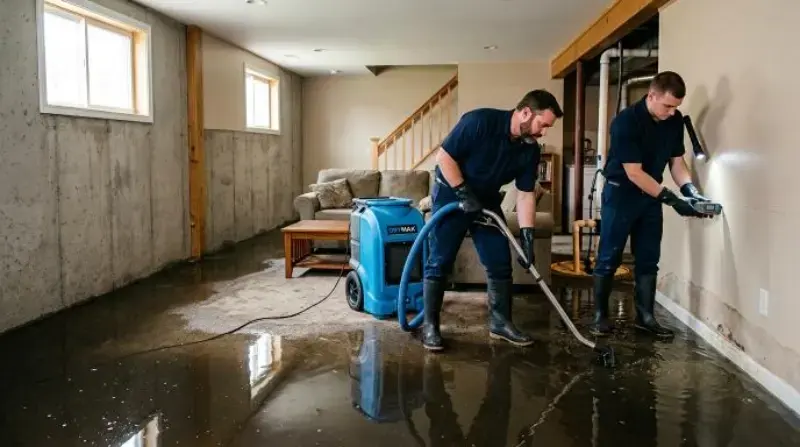
Two technicians extracting water from a flooded finished basement
Common sourceFloor drain, sump or seepage
WallsBlock and poured concrete
StandardIICRC S500 drying goal
Dispatch24/7, 8 Mile to 14 Mile
Work order

What to do the moment you find water in the basement

  1. Stay off the stairs if power is on

    Do not walk into basement water while outlets, the furnace or the water heater are energized.

  2. Find the source if safe

    Look for water rising at the floor drain, the sump pit, a wall crack or a pipe. It sets the water category.

  3. Photograph first

    Photograph the water line on walls, the drain and damaged storage before moving anything.

  4. Lift what you can, then call

    Move boxes and small items up the stairs, then call. Drying should start inside 24 to 48 hours.

Loss spec
Typical categoryCategory 2 from seepage and sump overflow; Category 3 from floor drain backup
Typical classClass 3 to 4 when block walls and carpet are soaked
EquipmentSubmersible pumps, truck-mounted extraction, LGR and desiccant dehumidifiers
Drying goalBlock and framing within 2 to 4 points of a dry reference
How the work is held to standard

How basement flooding cleanup is handled in Warren

Rapid local response

Warren water damage pros roll out around the clock, because water keeps soaking into block and subfloor after dark.

IICRC S500 drying standard

The drying team works to IICRC S500: structural drying, not just surface drying.

Claim-ready documentation

A moisture map, daily readings and timestamped photos go into the insurance file.

Macomb County water experts

Floor drains, sump pits and block-wall basements on slow clay are everyday work here.

Typical cost ranges

What does basement flooding cleanup cost in Warren, MI?

In Warren, MI, basement flooding cleanup typically runs $2,000 to $12,000 or more. A clean-water inch across an unfinished floor sits at the low end; a finished basement with carpet, drywall and a floor drain backup sits at the high end.

Unfinished basement

$2,000 to $4,000
  • Pump-out and extraction
  • Floor and wall drying
  • Daily readings

Finished rec room

$4,000 to $8,000
  • Carpet and pad removal
  • Flood cuts on wet drywall
  • Structural drying

Backup or deep water

$8,000 to $12,000+
  • Category 3 protocol
  • Containment and antimicrobial
  • Full removal and drying

The drivers are the water category, the square footage that got wet, the material class (drywall and carpet versus plaster, block and hardwood) and how fast drying started. For a planning number, try the Warren water damage cost calculator.

The assembly line

The basement flooding cleanup process, station by station

Every Warren job runs in the same order, because the order is what separates a finished dry-out from a cosmetic one.

  1. 01

    Map the moisture

    The tech who does the walkthrough finds the source and maps wet materials with thermal imaging and pinless meters before any equipment goes down.

  2. 02

    Extract

    The extraction crew pulls standing water with truck-mounted or portable extraction, so the water leaves the building instead of wicking further.

  3. 03

    Set the drying

    The drying team sizes air movers to each room's evaporation load and runs LGR dehumidifiers, with desiccants for dense materials.

  4. 04

    Read it daily

    Readings go into the drying log every day, and the plan changes when a wall or floor stops giving up water.

  5. 05

    Verify and document

    Equipment comes out when the wet material sits within 2 to 4 points of a dry reference, and the logs go into the claim file.

Why Warren basements take on water

Warren grew fast from the late 1940s through the 1960s, and nearly every house from that era sits on a full basement. Those basements share the same weak points: a floor drain tied to the sewer, footing drains around the outside of the walls, block or poured walls sitting in flat, slow-draining clay, and window wells at grade.

  • Floor drain backup: in heavy rain the sewer fills and water comes up through the lowest drain in the house.
  • Sump overflow: a pump that stops or cannot keep up lets the pit spill across the floor.
  • Seepage: saturated clay pushes water through cracks, block cores and the joint where the wall meets the floor.
  • Plumbing: a water heater, washer hose or supply line fails in the one room with no one watching.

What the cleanup involves

The tech who does the walkthrough starts at the source, because it decides the water category. Water that came up the floor drain is treated as Category 3 from the start, with protective gear and removal of the porous materials it touched. Seepage and clean plumbing water are usually Category 1 or 2 if the cleanup starts early.

Then the extraction crew pumps and extracts, the mitigation team removes wet carpet, pad and the bottom of any drywall that meters show cannot dry in place, and the drying team sets air movers and dehumidifiers. Concrete block holds a surprising amount of water, so basement walls often need longer drying and sometimes desiccant dehumidifiers when the basement is cold.

Throwing out soaked boxes and carpet is fine, but photograph them first. The claim file needs to show what was damaged before it went to the curb.

When the whole block floods at once

Warren has seen neighborhood-wide flooding before: the August 11, 2014 storm dropped several inches of rain on Metro Detroit in a few hours and filled thousands of basements across Warren and southern Macomb County. It led to a federal disaster declaration, FEMA DR-4195. On nights like that, the water is almost always sewer and storm water, and the cleanup follows the sewage backup protocol rather than a clean-water dry-out.

The National Weather Service flood safety page explains why basement water should be treated as contaminated after a storm until someone confirms the source.

Service area

Basement flooding cleanup across Warren and nearby Macomb County

Warren, MI and the Macomb County ZIP codes around it

The Warren restoration crew handles basement flooding cleanup in every Warren ZIP code: 48088, 48089, 48090, 48091, 48092, 48093 and 48397, from 8 Mile north to 14 Mile.

The same crews cover Center Line, Roseville, Eastpointe, Fraser, St. Clair Shores, Madison Heights and Hazel Park.

See every Warren area and ZIP

Questions

Basement Flooding Cleanup questions in Warren, MI

Is basement water from a floor drain dangerous?

Yes. Water that comes up through a floor drain has been in the sewer, so it is Category 3. Keep people and pets out of it, do not try to mop it, and have porous materials it touched removed rather than dried.

Can a finished basement be saved?

Usually the framing and much of the drywall can, when the water was clean and drying starts quickly. Carpet pad, soaked insulation and the lower part of wet drywall often come out. After a sewage backup, more has to go.

How long does it take to dry a basement?

A basement with clean water and prompt extraction usually dries in three to five days. Concrete block walls, a cold basement or a Category 3 loss can stretch that to a week or more. Equipment stays until the readings reach the drying goal.

Why do basements flood in Warren when it rains hard?

Most Warren basements have a floor drain connected to the sewer and footing drains around the walls, and the city sits on flat clay that drains slowly. When a storm overloads the sewer, water backs up through the lowest drain in the house.

Does homeowners insurance cover a flooded basement?

It depends on the source. Plumbing failures are often covered; sewer and drain backup usually needs a backup endorsement; surface flooding needs a flood policy. Coverage depends on your policy, so it is worth checking with your own insurer.

What can I do to prevent the next basement flood?

A backwater valve on the sewer lateral, a sump pump with battery backup, downspouts extended away from the foundation and a standpipe or plug on the floor drain during storms all reduce the risk. The basement flood readiness check scores your setup.

Should I run a dehumidifier myself?

A household dehumidifier helps after the water is gone, but it cannot keep up with a soaked basement. Commercial LGR dehumidifiers and air movers sized to the space do the structural drying.

Emergency water removal

Water in your Warren basement? Call now.

Pump-out, removal of what cannot be saved and structural drying of block and poured walls across Warren.

(888) 612-9219Get the basement dry-out moving tonight
Call (888) 612-9219 24/7